COMMERCIALIZED
Lower-carbon gasoline
Generators, small equipment, fleets, performance and passenger cars
Cleaner combustion | Fuel efficiency | Lower smoke, odor and deposits
EXISTING EQUIPMENT · EVOLVED
GIDI Clean Technology Co., Ltd.
Lower-carbon liquid fuels & products × AI measurement & verification × Exhaust-carbon recovery & carbon materials × Motor & product applications
ESGENTERTAINMENTESGEnergy efficiency first. Decarbonisation alongside.
Explore diesel and gasoline services, pilot conditions and product maturity ↗GIDI / EXPLORE
GIDI develops lower-carbon liquid fuels and products for existing vehicles and equipment, with AI and measurement to assess results.
Choose a topic. Open only what you need.Fuels, lubricants, coolant and equipment care.
02Find your application, plan a trial and assess finance readiness.
03Inspection records, field measurements, AI and verification.
04Equipment lifecycle, operating frameworks and investment.
05Carbon recovery, advanced materials and motor applications.
06Company introduction, people and regional activities.
FOUR FLUIDS · ONE SYSTEM

COMMERCIALIZED
Generators, small equipment, fleets, performance and passenger cars
Cleaner combustion | Fuel efficiency | Lower smoke, odor and deposits
FIELD VALIDATION
Mining, heavy equipment, generators, agriculture, fleets and marine
Lower smoke & odor | Fuel efficiency | Low-RPM torque
FIELD VALIDATION
Robotics, automation, generators, heavy equipment, fleets and marine
Lower friction & heat | Less wear, energy use and downtime
IN DEVELOPMENT
Fleets, agriculture, heavy equipment, generators, cars and marine
Thermal stability | Less overheating and downtime
ROBOTICS & AUTOMATION
Potential applications include robotic joints, bearings, gearboxes, reducers, linear guides and high-frequency motion components—targeting lower friction, heat, wear, energy use and unplanned downtime.
OPERATIONAL VALUE FRAMEWORK
Translate field improvements into operational, economic and environmental value.
These are target operating outcomes—not guaranteed results. Each asset and duty cycle should be verified through a controlled field trial and MRV.MRV
VIEW SUPPLIED FRAMEWORK DECK↗PHYSICAL INTERVENTION · EQUIPMENT CARE
Designed for engine-oil and transmission-oil pans, the GIDI Dual-System Carbon Reduction Magnet captures ferrous wear particles circulating in the fluid system—helping protect operating efficiency and reduce avoidable maintenance exposure.
GIDICAPTURE WEAR · PROTECT EFFICIENCY · REDUCE MAINTENANCE COSTSApplication fit and outcomes depend on equipment design, operating conditions, installation and inspection. Validate through a controlled field trial.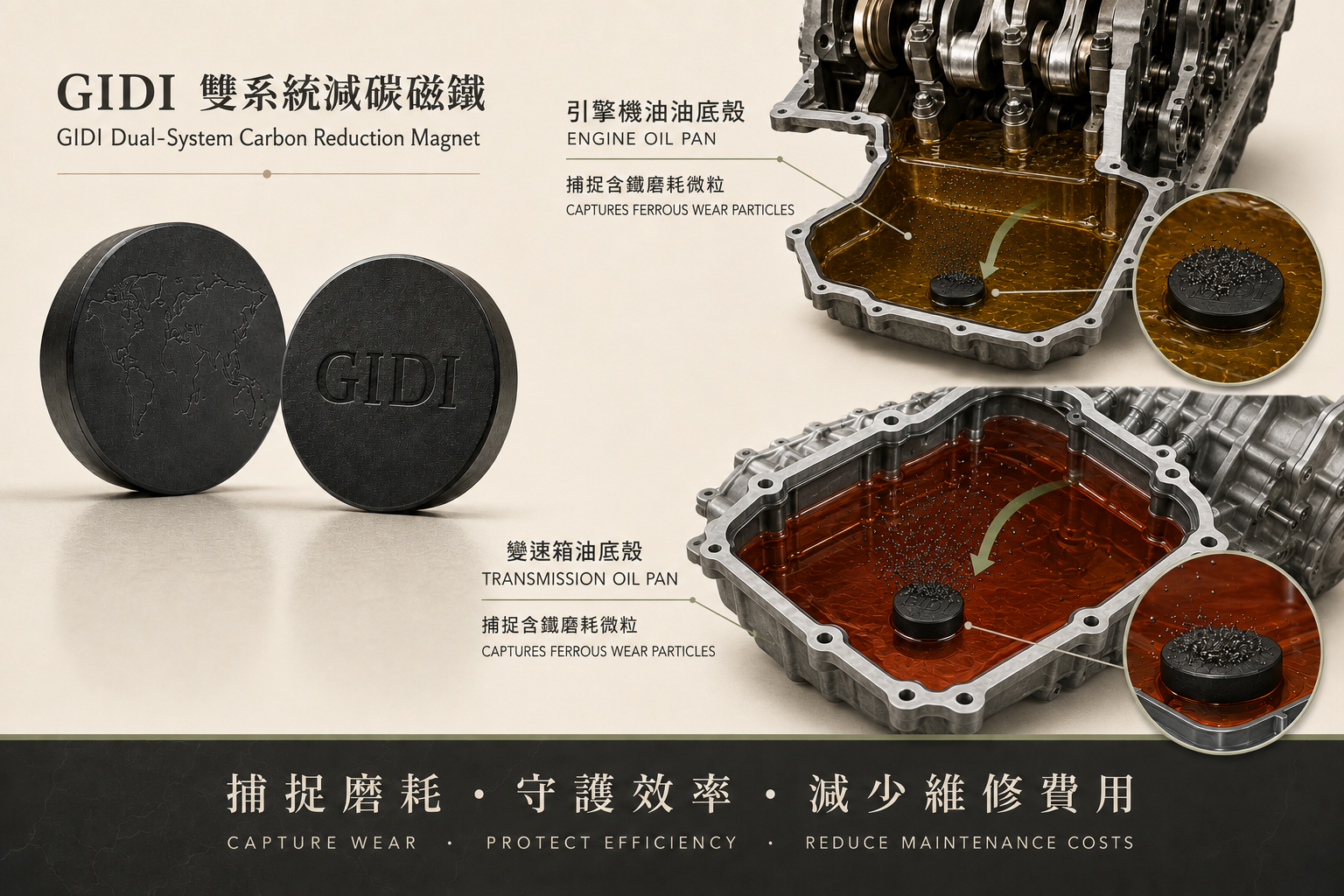
Start with your equipment and operating problem. Define a baseline, apply the intervention, compare measurements and assemble traceable evidence. This can support assessment of suitable finance options; eligibility and lending decisions remain with the provider.
Discuss GIDI 369 Controlled Pilot ↗START HEREChoose your organisation
Fuel · heat · smoke · downtime
VIEW →02Diesel efficiency · field data
VIEW →03Vehicle performance · MRV records
VIEW →04Lower-carbon energy · air monitoring
VIEW →05Controlled pilots · independent evidence
VIEW →06ESG data · scalable projects
VIEW →BUILT FOR EXISTING EQUIPMENT
Reduce emissions, energy costs and operational risk—without immediately replacing existing diesel assets. Every application begins with a controlled field trial and ends with evidence that can support a real decision.
Haul trucks · Excavators · Loaders · Fixed diesel assets
Construction · Events · Remote sites · Backup and rental fleets
Tractors · Harvesters · Irrigation pumps · Farm generators
Earthmoving machinery · Compressors · Site vehicles · Mobile power
Trucks · Buses · Service fleets · Logistics vehicles
Marine diesel · Off-grid equipment · Remote and isolated assets
AGRICULTURE & NON-ROAD MACHINERY
High-load diesel duty cycles, torque demand and long operating hours.
Seasonal peak loads, dust exposure and downtime-sensitive operation.
Stationary engines where fuel, temperature and runtime can be measured.
Agricultural, forestry, construction and industrial engine fleets.
Regulatory note: GIDI does not claim EU Stage V type approval or certification for a machine or engine unless formally issued by an authorized body. Any compliance determination remains asset-, engine- and jurisdiction-specific.GIDI EU Stage V
INTEGRATED DECARBONIZATION
ESG
From baselines and test boundaries to monitoring and third-party verification, GIDI converts operational improvements into traceable ESG/MRV records.ESG/MRV
Track fuel use, CO, CO₂, HC, NOx, particulates, smoke, odor and equipment temperature against a defined baseline.
Overlay personnel location, exposure zones, temperature and risk levels to support alerts, evacuation and operational decisions.
Define boundaries, assets, duty cycles, periods, methods and accountability—supported by source records and third-party MRV.
GREEN FINANCE & PUBLIC FUNDING
GIDI connects field performance, ESG data and MRV evidence so customers can evaluate green loans, sustainability-linked finance, equipment-upgrade incentives and public funding opportunities.
GIDI ESG MRVUse defined assets, budgets, savings targets and verified indicators to support lender assessment.
Translate operational KPIs into measurable performance targets and reporting inputs.
Package the project scope, innovation, emissions impact, budget, milestones and MRV plan for eligible programs.
Funding eligibility and approval depend on the jurisdiction, applicant, program rules, timing and assessment outcome. GIDI supports project structuring and evidence preparation but does not guarantee funding approval.GIDI
Project integration
Fluids & equipment
Monitoring & verification
Performance & subscription
Technology development roadmap —
GIDI 369 Controlled Pilot
If you manage fleets, generators, agricultural machinery, mining equipment, marine assets or live-event power systems, let's define the baseline, test boundary, indicators and verification method together.
ESG
EU POLICY ALIGNMENT · COUNTEMISSIONSEU
CO, HC, temperature, inspection records, images and mileage.
Vehicle ID, actual fuel use, distance, load, route, idling and maintenance state.
CO₂e calculation using a common method, audit trail and independent verification.
EVIDENCE BEFORE CLAIMS
14
Latest reviewed internal records: 25 October 2026. Outreach and proposals are not partnerships, completed pilots, verified performance or funding decisions.
Engaging equipment owners and supply-chain operators about controlled efficiency and MRV pilots. Sites, equipment access and commercial terms require written agreement.
Technical preparation and dialogue continue. This does not announce government endorsement, pilot approval or funding.
Australian field-data and calculation templates have been prepared. Demonstration data is illustrative; independent verification remains pending.
The commercial focus is repeatable equipment care, recurring MRV services and evidence-led scaling. No new funding award is announced here.
Capture, materials and motor applications remain research concepts, separate from current service proposals.
Individual cases and estimates do not guarantee identical results. Performance should be verified for each asset and duty cycle.
MRV
FIELD EVIDENCE · 2014–2019
SGS ORIGINAL TEST REPORTS
Original SGS Taiwan laboratory reportsCE/2017/61379andCV/2018/30061are available below. Across their listed screening matrices, 28 potential hazardous substances are reported as N.D.—below the applicable method detection limits.
SGS Taiwan 28 N.D.

SGS report referenceCE/2017/61379
Submitted 2017/06/08 · report sample name: Fuel-system combustion improver
SGS report referenceCV/2018/30061
Submitted 2018/03/19 · report sample name: Engine-oil conditioner


CE/2017/613792017/06/08
Original report sample name: Fuel-system combustion improver

CV/2018/300612018/03/19
Original report sample name: Engine-oil conditioner
Evidence boundary:N.D. means below the method detection limit for the submitted sample and listed method. It does not by itself establish universal non-toxicity, regulatory approval, or identical results for every product or batch.N.D.
VIEW SUPPLIED SGS SUMMARY DECKSGS↗Compiled from seven gasoline-vehicle inspection records. The stated limits are CO 1.2% and HC 220 ppm. Values shown are post-maintenance snapshots—not universal reduction claims.
7
ORIGINAL RECORDS
Selected official vehicle inspection records are shown with enlarged CO, HC and CO₂ fields. Personal identifiers are redacted; dates, limits and test results remain unchanged.
Engine temperature observation


89°C → 80.3°C
Exhaust temperature observation


−15.5°C −22%
COMPONENT OBSERVATION


MRV
PROCESS ON RECORD
Brand and field-maintenance record
Fuel-performance observation
Fuel and power-performance method
Product and application record
Low-carbon maintenance field record
Short-form field observation
Instructional field record
Low-carbon maintenance field record
Independent workshop visit documenting real-world low-carbon maintenance practice · VLOG
Videos document procedures and historical field activity. They are not standalone proof of universal fuel-saving or emissions-reduction rates; formal claims require controlled testing and third-party MRV.
MORE RECORDS · ↗CARBON REDUCTION · COMBUSTION EFFICIENCY · ESG CHECKLIST
Convert field observations into structured ESG indicators: baseline, method, result, source evidence and the next verification step.ESG
89 → 80.3°C · difference −8.7°C
69.6 → 54.1°C · difference −15.5°C
7 records · stated limit 1.2%
7 records · stated limit 220 ppm
Asset, fuel, load, runtime, duty cycle and environmental conditions.
Fuel use, CO, HC, CO₂, NOx, particulates and temperature.
Compare like-for-like conditions using disclosed emission factors and assumptions.
Preserve raw data, evidence, KPI ownership, controls and MRV verification.
Evidence boundaryLower temperature may indicate improved thermal management, but does not alone prove lower CO₂ emissions or higher combustion efficiency. A formal carbon calculation requires comparable fuel consumption, runtime, load and emission-factor data.CO₂
INDUSTRIAL AI · CLEAN TECHNOLOGY
Germany is not abandoning Industry 4.0. The next phase builds on connected equipment, automation and digital factories—then uses AI to turn operating data into better decisions, higher efficiency and lower risk.4.0 AI
Connect fuel use, load, runtime, temperature and emissions to identify where controlled trials and operating changes may improve performance.
Use trends and anomaly detection to support thermal-risk review, predictive maintenance and reduced unplanned downtime.
Preserve baselines, raw data, methods and verification records for ESG disclosure, public funding and institutional review.
GIDI positioning:Industrial AI is the decision layer connecting lower-carbon fluids, field sensing and ESG/MRV—not a claim that every machine is already autonomously controlled. Each deployment is defined and verified for its actual asset and duty cycle.GIDI AI ESG/MRV
AI CARBON OPERATIONS CENTER · V2.0
AI
Consolidate energy, fuel, emissions, temperature, exposure, maintenance and project KPIs in one management view.
Preserve source records, timestamps, test boundaries, calculation logic, approvals and third-party verification.
→ → →Detect anomalies, compare baselines and prioritize actions while keeping accountable people in control of every decision.
AICombine personnel position, pollution zones, temperature and alert thresholds for mobile, on-site and control-room warnings.
Link each asset, baseline, intervention, measured result, evidence owner and financing pathway in a controlled register.
ESGStructure Scope 1, 2 and 3 inventories and separately disclose potential Scope 4 avoided emissions without netting them against the inventory.
GIDI structures operational evidence so customers can map relevant information into applicable sustainability disclosures. Final materiality, boundaries and compliance remain the reporting entity's responsibility.
Implementation boundary:This is GIDI's deployable data and governance architecture. Dashboard modules, sensors, thresholds, integrations and reporting mappings are configured for each field trial; the conceptual interface does not claim that every function is already operating at every site.GIDI
SEE THE INVISIBLE
Safer, measurable operations.AI

GIDI's monitoring concept can connect aerial sensing, source-location analysis, heatmaps, time and location records across classic-car events, motorsport venues, fleets, farms, mines and diesel-equipment sites.
GIDI AIConceptual demonstration only. Data shown in the image—including AQI, detected sources, coordinates and confidence—is illustrative and is not presented as a completed GIDI field measurement.GIDI AI AQI GIDIPhysical care → AI evidence → circular value. Explore the flagship investment project and the models supporting it.
Explore GIDI 369 ↗
GIDI 369 Sustainable Equipment Lifecycle
A practical framework for extending useful vehicle life—from physical care and measurable evidence to responsible recovery.
GIDI starts with fuel-powered vehicles and diesel equipment still on the road and at work. We use our own products and technologies to reduce fuel consumption and pollutant emissions, and improve equipment efficiency. We then combine government inspection data, applicable EPA methods and AI-MRV to turn these improvements into traceable, verifiable data for business decisions.
This connects physical care with AI evidence in GIDI 369. Historical gasoline-vehicle inspections provide the starting evidence; diesel applications and the full AI-MRV workflow remain under validation. EPA carbon-balance calculations require HC, CO and CO₂ mass emissions, fuel properties and applicable test conditions. CO/HC concentrations alone cannot establish fuel savings or CO₂ reductions. Reference to a method is not EPA certification.Method: 40 CFR 600.113-12 ↗
Evidence boundary:369 is GIDI's operating framework—not a scientific claim about Nikola Tesla. Converting exhaust or recovered carbon into carbon nanotubes, conductive carbon or synthetic diamond remains an R&D pathway until independently demonstrated.
THE GIDI FIVE-LAYER STACK
GIDI is not only a fluid supplier. We connect physical intervention, equipment performance, sensing, AI and MRV to business and financial decisions.
Lower-carbon gasoline, diesel, lubricants and thermal-management fluids act on the physical system.
PASTExamine combustion, friction, temperature, fuel use, emissions and equipment health.
PAST → PRESENTConnect field sensors, UAVs, thermal imaging and operational records across real duty cycles.
PRESENTPreserve baselines, detect anomalies and build traceable evidence for independent review.
PRESENT · TRANSFORMATIONSupport ESG, procurement, insurance, finance, carbon assets and scale-up decisions.
FUTURE VALUEGIDI starts with energy and equipment, then uses monitoring, AI and MRV to turn measurable efficiency improvement into verifiable data assets.
PHYSICAL IMPROVEMENT → VERIFIABLE DATA → DECISION VALUEGIDI uses specialist AI roles to detect signals, structure evidence, challenge assumptions and prepare actions. Operators, engineers, verifiers and accountable leaders remain in control.
The demo uses illustrative data. The secure workspace protects assigned client projects and verifier access.
We research recovering carbon from exhaust and converting it into carbon nanotubes, conductive carbon and synthetic diamond, with future carbon-nanotube motors, diamond-material motor applications and related products in view.
Long-term R&D. Technical performance, manufacturing cost and commercial feasibility remain to be validated.
GIDI Clean Technology develops fuel, lubrication and cooling products, as well as a range of additives, for existing engines and industrial equipment. These products are based on petroleum and petrochemical feedstocks and use conversion and processing technologies developed in-house.
Through these products and supporting maintenance techniques, the company aims to improve equipment operating efficiency, maintenance condition and service life, and to build an AI-MRV measurement and data-management system to verify actual results and their commercial value.
TEAM & EXPERT NETWORK
Seven experts spanning technology applications, international cooperation, information governance, energy, materials and legal affairs.
 Co-Founder · Technology Applications & Commercialisation
Drawing on long-term experience with vehicles and equipment in real operating environments, Wei-Lun connects lower-carbon fluid technologies with market needs, brand communication and cross-border business partnerships. His career spans vehicle applications, motorsport operations and media, with an emphasis on creating practical value for end users.
FULL PROFILE ↗INDIVIDUAL PDF · ENGLISH ↧ Co-Founder · International Cooperation & One Health
Adem combines expertise in agricultural biosurveillance, animal health and One Health with cross-regional project development. His work is closely related to institutional engagement in North Africa, the Maghreb and MENA, connecting local agricultural and environmental concerns with the requirements of international partnerships.
FULL PROFILE ↗INDIVIDUAL PDF · ENGLISH ↧ Co-Founder · Information Security & Data Governance
Yi-Shun brings together skills in information management, machine learning, communications engineering and network security. His approach focuses on protecting customer information, managing access rights, ensuring consistent records and maintaining data-processing security, supported by Microsoft certifications and military communications experience.
FULL PROFILE ↗INDIVIDUAL PDF · ENGLISH ↧ EVO PMVA · Energy Measurement, ESG & Carbon Assets Expert
Lan Chia-Lin (Zoe Lan) is an EVO-certified Performance Measurement and Verification Analyst (PMVA), certificate 3533375810ZL, and holds Taiwan’s iPAS Net-Zero Carbon Emission Planning Administrator qualification at Specialist Level. Her background combines information management, ESCO energy services, storage and electricity trading, greenhouse-gas accounting, agricultural carbon footprints and project financial analysis. She supports evidence-based measurement and verification, ESG data and energy-performance decisions.
FULL PROFILE ↗INDIVIDUAL PDF · ENGLISH ↧ Advanced Materials & Energy Technology Expert
Dr. Huang has a research background in energy and nanoscale materials, covering supercapacitors, electrochemistry, flexible electronics, conductive materials and advanced microstructures. His work combines university teaching, research institute experience and international academic exchange, with an emphasis on understanding technological feasibility through material properties and experimental methods.
FULL PROFILE ↗INDIVIDUAL PDF · ENGLISH ↧Dr. Liu combines a materials-science background with biotechnology entrepreneurship. His research covers natural-polymer biomaterials, self-assembled nanocarriers and controlled-release systems. His experience in patented inventions, scientific publications and technology scale-up focuses on turning research findings into viable products and manufacturing processes.
FULL PROFILE ↗INDIVIDUAL PDF · ENGLISH ↧ Legal Affairs, Compliance & Institutional Governance Expert
Chien-Cheng has approximately 18 years of corporate legal and compliance management experience across industries. His expertise spans contracts, corporate governance, public procurement, grant programmes, data protection and intellectual property. He brings both public-sector programme and corporate management perspectives to multidisciplinary cooperation.
FULL PROFILE ↗INDIVIDUAL PDF · ENGLISH ↧TARGET REGIONS · PARTNERSHIP ENTRY POINTS
Automotive, agriculture, industry and maritime shipping.
DISCUSS A US PILOT ↗Mining and construction generators, heavy transport, marine assets, agricultural machinery and lower-emission live-event power.
Commercialisation base with 14 years of field activity, 1,200+ gasoline-vehicle applications and historical inspection evidence.
Agriculture and non-road machinery are the priority pathway, supported by an EU Stage V-aware validation and evidence strategy.
High-load energy applications and agricultural One Health pathways across Gulf and North African markets, with Tunisia as a gateway to Sub-Saharan partnerships.
Market-entry priorities are partnership and pilot pathways, not claims of regulatory approval or commercial availability in every jurisdiction.


